



Myths and Legends
Many myths and legends exist surrounding the creation of the Triumph Stag and its foibles. This short history is an attempt to clarify inaccuracies often published by the classic car motoring press and repeated as truths for decades.
Selected passages are quotations by the very people involved in the development of the Stag and the relevant acknowledgements are mentioned at the foot of this article.
It is a well coined phrase, but the Stag went from ‘zero to hero’ in around 20 or more years. It was doomed to failure from the outset due to a combination of lack of development, poor quality assurance, inadequate maintenance training, poor reliability and a war in the Middle-East !
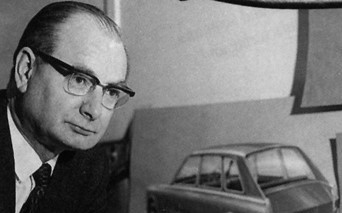
Harry Webster, Standard-Triumph Director of Engineering & Development first discovered the talents of Giovanni Michelotti as Chief Stylist of a Turin based specialist coach builder, Vignale. After Michelotti had left to set up his own design studio and designed many of Standard Triumph’s models, Harry received a request from Michelotti in 1965 to supply him with a Triumph 2000, so that he could do a styling piece for the forthcoming Geneva Motor Show.
The car started as a Michelotti styling experiment for the 1966 Geneva Auto Show. Giovanni Michelotti had previously styled the 2000 saloon for Triumph and he asked Harry Webster, Director of Engineering at Triumph, for a car to use as a donor for his show project. Webster agreed, on the understanding that if he liked what Michelotti produced, Standard – Triumph could have first refusal on the concept and it would not be included in the Geneva Show.
The donor car sent to Turin was a 1964 saloon which had been previously been used internally at Canley and after its final duties as a support car for the 1965 Le Mans Spitfire team had been completed, it was driven to Italy and left for Michelotti to cut and shape.
Harry Webster, who was a long-time friend of Giovanni Michelotti, absolutely loved the design when he saw it, as did the Triumph directors, and in the summer of 1966 the car was collected from Turin and driven back to Coventry and the Stag was born. The name Stag was originally the ‘code’ name given to the model, but was adopted as the actual name, as it was preferred to all alternatives submitted for consideration during development in 1966.
An interesting aside is that Triumph liked the eventual result of the front and rear end treatments of the new car so much that, when it came to revamp the 2000 range in 1969, they used the styling lines of the Stag. Ironically, due to the hold up in the launch of the Stag, the ‘Mk II’ Triumph 2000/2500s were released 8 months before the Stag, making it look as if the Stag design copied that of the saloons, when in fact it was the other way round.
Prototype

The car that arrived at Canley, a two-door drop head, had little in common with the styling of its progenitor 2000, but it retained the suspension and drive line. The design was taken forward to production by the Engineering Department at Triumph and it was they who added the T-bar arrangement to cure the scuttle shake of the original open car.
The original idea was to take two years developing the concept to launch in 1968. It didn’t happen ! It was late by a further two years due to many problems, not least by financial constraints following the merger between Leyland Motors and BMC to become British Leyland in 1968; engine selection for the final production example played a big part. Many versions were tried, starting with the initial straight 6 cylinder engine of the Triumph 2000 saloon, but ending up after many months of running tests around the world with an in house developed Triumph V8 engine of 3-litres which was exclusively used in the Stag model.
Engine

Given that British Leyland had acquired the rights to, and was manufacturing, the excellent small block Buick V8 engine that found its way into Rovers, Land Rovers and Range Rovers many ask why Triumph were allowed to continue to develop and produce their own engine and have suggested that it was down to internal British Leyland rivalry between Rover and Triumph, with Triumph engineers declaring the Buick / Rover V8 could not be made to fit – which it can. In fact the problem was simply down to finances and the ability to supply with British Leyland being unable to satisfy demand for the Rover engine without making a cost prohibitive further investment to enlarge production facilities and delaying the Stags market launch.
For the day the V8 Stag engine was a highly advanced OHC unit producing respectable horsepower for its capacity. Furthermore it would utilise the tooling created for the 45˚ banked 4 cylinder Triumph Dolomite block developed for the Saab 99. The tooling had been created with the intention of it being used for the future development a complete range of banked 4, V6 and V8 engines of varying capacities. By this time Harry Webster had been moved to Austin-Morris Division of the conglomerate and Spen King was appointed from Rover to further develop the Stag to launch. Spen’s quest for more bhp and lower end torque resulted in the increase of the V8 from 2.5 litres to 3 litres and the reversion to carburettors away from fuel injection, which would have eventually run into problems with US emission directives anyway.
The Stag was eventually launched to the UK public on 9th June 1970 as a convertible with a manually stowable soft top, with a detachable hard top or with both soft top and hard top and caused quite a stir in the motoring press at the time – copies of news articles, motoring press publications, brochures and Press Launch documents may be found in the ARCHIVE section.
The Launch

Technically, the car was very advanced at launch in 1970, including independent suspension all round, servo-assisted disc/drum brakes, power steering, a steering column that could be adjusted for rake (up / down) and for reach (in / out),a cigar lighter, sundym tinted glass and electric windows, folding front seats that could be reclined and adjusted for height and well as fore and aft – all this came as standard equipment. The launch model was a 4-speed manual with overdrive, originally an option, like the Borg-Warner 3-speed automatic box.
With its refined styling, distinctive roll-over bar, (originally installed to stiffen the body to reduce scuttle-shake, rather than a safety feature often quoted by motoring press), and hard/soft top options, the car was widely acclaimed. Unhappily for British Leyland it was not so widely bought.
Hampered by numerous warranty claims both here and in the US following its launch there, the Stag sold poorly in America, its prime target market. Further sales were lost following the Middle East Oil crisis of 1973/4 following revolution and outbreak of war (as indeed did most so-called gas-guzzling models). The Stag was withdrawn from the US market in 1973.
Sales at home, were also affected by reliability issues and a poor reputation for mechanical problems…some journalists labelling the model as the Triumph Snag ! Only some of these initial problems were resolved by Triumph, despite numerous improvements through its production run.
But such issues need to viewed in context. The 70’s were a period of unrest with strikes and industrial disputes aplenty in the car industry and for British Leyland in particular. Quality assurance wasn’t what we’ve come to expect today with for example casting sand not being fully purged from engine blocks at the factory – one engine failure is recounted to have produced a cup and a half of casting sand being found in the oil on tear down. Hardly surprising that it ran its main bearings.
If that wasn’t bad enough it wasn’t fully understood at the time that having a an engine block of cast iron with an aluminium head caused an electrolytic reaction which could result in the silting up of the waterways and the radiator unless the engine was run with a good quality anti-freeze with inhibitor all year round and coupled with an annual reverse flush of the cooling system. To compound the issue if the radiator silted up the car would overheat and this could lead the head gasket being blown – requiring the head to be skimmed and the cooling system to be reverse flushed to avoid a reoccurrence. This was something that was initially overlooked. With the water pump high in the vee of the engine even a small loss of coolant can have an adverse effect on circulation.
At the outset sales projections were estimated by the Standard Triumph Sales & Marketing team at around 12,000 units a year. Sadly, sales achieved only slightly more than double that in 7 years production ! 1973 proved to be the highest sales year remarkably ! It quickly fell from its peak of 5,500 units, to 3,442 in 1974, then 2,898 in 1975, stabilizing for two years until only 1,800 or so units in its final year. Sales figures were never sufficient to earn a place in the line-up of a volume car manufacturer…and thus production ended in June 1977.
Nevertheless, to the many thousands of fans of the car, not least that of the Stag Owners Club founder, Tony Hart, the car did not die. It currently thrives and it is estimated that at least 46%, of UK cars and in excess of 35% of the worldwide total original production run of 25,939 cars survive, which has to be one of the most remarkable events considering how the car became the butt of so many jokes and criticisms, both during production and after its demise.
Since production ceased an army of owners, enthusiasts and specialist parts suppliers have engineered the foibles out of the car and have developed it into the reliable and prestigious car it was always destined to be.
Improvements continue today, with the assistance of Stag Owners Club Tooling Fund Limited (SOCTFL), which exists solely with the intention of ensuring that obsolete parts are remanufactured so survival is assured and a place is reserved on our roads for this unique Italian designed, but British made car. Each member of the Stag Owners Club owns one share in SOCTFL thus ensuring every members commitment to that goal.
Acknowledgements: The late Harry Webster and Brian Bayliss; “Triumph Stag” by James Taylor; British Motor Heritage Trust, Gaydon
Original article written by Derek Athey and updated and expanded by Roger Gray
Triumph Stag Documentary
The following video is a 40 minute documentary called “The Dream Car” and gives a rare insight into the development of the Triumph Stag. Made with the agreement of British Leyland it features Harry Webster, Spen King and other notables involved in bringing this car to market.